

Our year-long test for a forecasting model has ended, in a failure. In mid-June 2025, I build a “simple” forecasting model for forecasting the medium-term path of the U.S. real Gross Domestic Product, or real GDP. It yielded an intriguing trajectory for the U.S. economy.
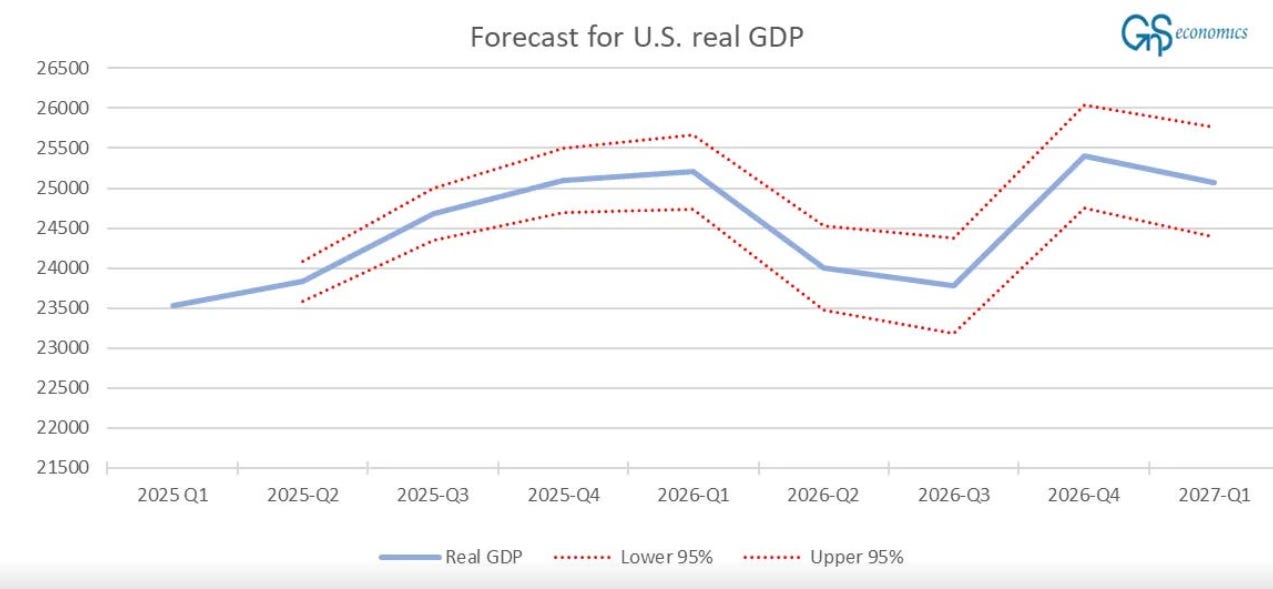
I naturally had my doubts, mostly because of the slump it foresaw manifesting in the second quarter of this year. When the model correctly anticipated the acceleration of the U.S. economy during Q3 and continued to forecast a slump for the past quarter, I started to pay more attention to it. However, at the end of last year, the model began to miss its predictions, and my doubts towards it started to grow.
In January, I had speculated on the stochastic trend we assumed to drive the U.S. GDP series. The idea was that this hidden trend was seeing something in the future of the U.S. economy that we could not. As the year progressed, this theory started to look less and less likely. From Weekly Forecasts 22/2026:
However, while the U.S. consumer is hurting, for example, the Aruoba-Diebold-Scotti Business Conditions Index, which we have been using as a basis for our nowcasts of U.S. GDP growth, does not show such a collapse. It is thus likely that our model is exaggerating the magnitude of the downturn.
The first estimate of the second quarter (real) GDP published on 30 July essentially confirmed our suspicion. Figure 2 explains.
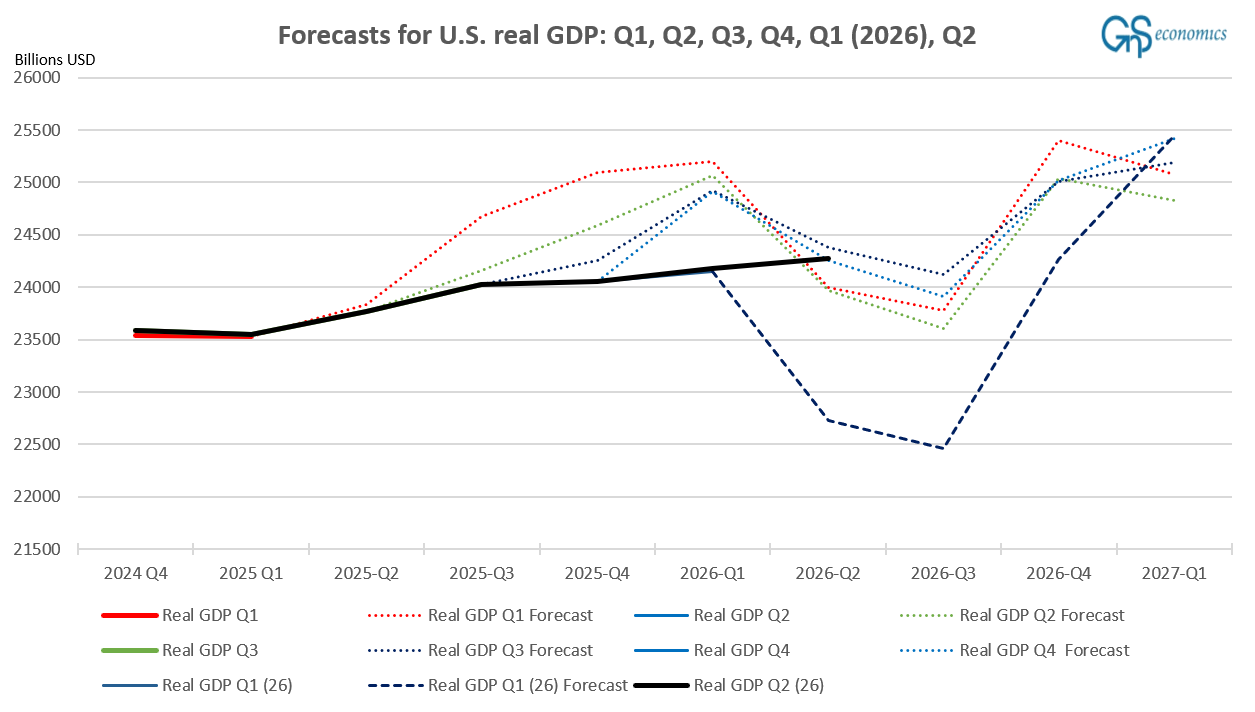
There was no slump or collapse. The U.S. real GDP blowed through the past quarter without a hitch. And so, this model goes to trash.
I have to admit that I am somewhat disappointed. I spent a big part of my academic career looking into stochastic trends, or unit root processes and hoped they would provide straightforward means for predicting the turning points of the U.S. economy. That wish is now in the gutters, and it is back to the drawing board for us.
Tuomas
Disclaimer:
The information contained herein is current as of the date of this entry. The information presented here is considered reliable, but its accuracy is not guaranteed. Changes may occur in the circumstances after the date of this entry, and the information contained in this post may not hold true in the future.
No information contained in this entry should be construed as investment advice nor advice on the safety of banks. Neither GnS Economics nor Tuomas Malinen can be held responsible for errors or omissions in the data presented. Readers should always consult their own personal financial or investment advisor before making any investment decision or decision about the banks in which they hold their money. Readers are solely responsible for the risks associated with using this post.
Readers must assess the risks and legal, tax, business, financial, or other consequences of their actions. GnS Economics and Tuomas Malinen cannot be held i) responsible for any decision taken, act, or omission or ii) liable for damages caused by such measures.
The views of Tuomas are his own. They may or may not be endorsed and supported by the partners and staff of GnS Economics.