

Topics:
Global downturn looks to be here.
Forecasting OECD’s leading indicators is complicated by common factors.
Three yield curves indicate that the U.S. is very close to a recession.
This week we first update OECD’s leading indicators. They indicate that the downturn in the global business is likely to be upon us.
Then we provide you with something of an introduction to common factors in the analysis of cross-section (e.g., countries) of time series. Their analysis is something that was just emerging when I was in academia (I left late 2017). They are crucial, because left unchecked, they can bias forecasts in a very detrimental way.
Common factors can be analyzed with EViews 14, but the problem we encountered was that not all programs used to analyze them, written by EViews users, work in its latest version (14). Thus, we need to work our way around this issue by using two- or three-step estimation methods. This takes time, which is why we cannot present these Factor-Augmented Vector Autoregression forecasts here.
We end with an update to the yield curves of the U.S. They convey a unified message that the U.S. economy has entered a phase with a high risk of recession.
Tuomas
Has the global downturn arrived?
We can now confirm a few trends that we speculated about in May. Figure 1 presents OECD’s leading indicators for China, the G-20, Japan, four major European countries, and the U.S.1
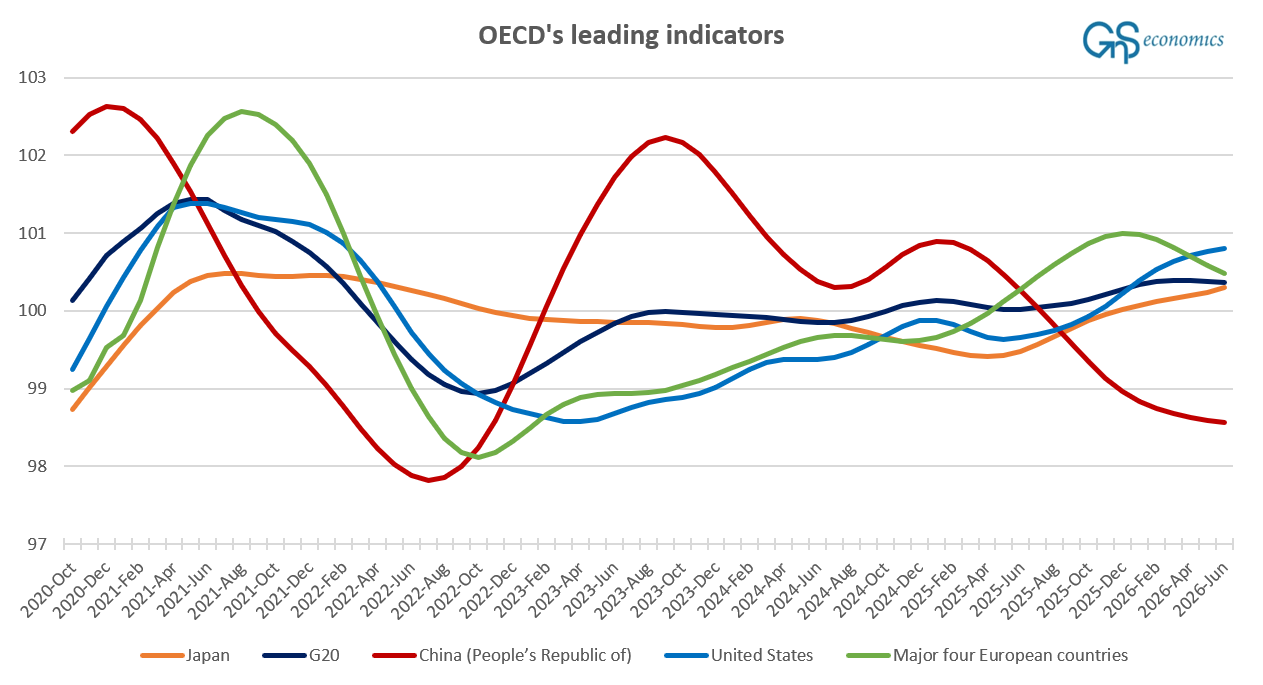
First, Figure 1 confirms that the downturn of the four major European countries (France, Germany, Italy, and the U.K.) has commenced. Secondly, it shows that the Chinese economy’s downturn has continued, but the decline has slowed in the past two to three months. This is indicative of an approaching increase in stimulus by Beijing and hence another upturn in the Chinese economy. We currently consider that this cyclicality of the Chinese economy reflects Beijing’s efforts to controllably cool and de-lever the economy. Because debt is still growing much faster than GDP, this strategy is not working (see, e.g., the 2024 analysis by Tuomas).
Moreover, the U.S. economy continues on an upward trajectory, while the pace of acceleration is slowing, which is indicative of a downturn ahead. The global business cycle (G-20) has moderated, which indicates an imminent downturn (which can be gradual). Figure 2 puts the recent developments in historical perspective.
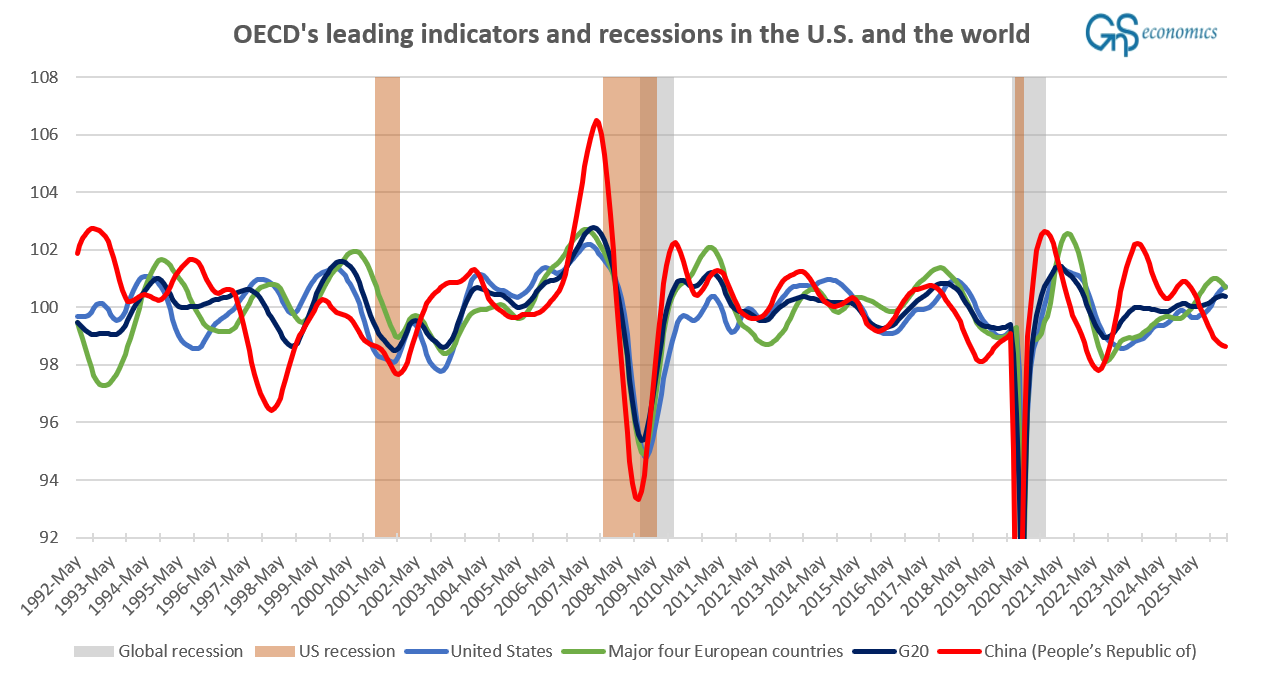
The only recent development that “registers” in the historical data is the downturn of China. It is very close to reaching the Ukrainian War bottom (in the spring of 2022), which is (also) indicative that Beijing will shortly ramp up the credit machines once again.
Historically, the global business cycle has followed that of China since the late 1990s. For this relationship to hold, the G-20 economies would need to see a notable slowing down, or, conversely, China would need to see a major economic boom. As the latter is relatively unlikely, we consider that all major economies and hence the world economy are on the brink of a major downturn, which is likely to turn into a recession and even to a global economic depression.
Let’s now turn into forecasting. Like Tuomas noted in the introduction, EViews provides us with an important observation, which is likely to determine how we need to approach the forecasting of the leading indicators in the future.
Common factors in leading indicators
The latest patch of updates from the OECD included major revisions to the data. Figure 3 presents the revised data with our May forecast.2
