

Contents:
Grand (Unified) Geopolitical Theory in the Middle East.
After 26 days of war, most of Iranian military arsenal is still intact (by Patricia Marins).
The Iranian play altering the Eurasian “chessboard.”
We are approaching a crucial turning point in the war in the Middle East. First President Trump issued and then backed out of his 48-hour deadline based on good news on “negotiations” that never happened. Now, we are running with another deadline, which ends on Saturday. In the worst case, this deadline will mark the beginning of a new Vietnam War with dire consequences for the world.
This week, we’ll provide you with information on both the larger play behind the conflict in the Middle East and updated information on the capabilities of Iran. We start with the extension of my Grand (Unified) Geopolitical Theory to the Middle East. It shows how President Trump’s administration is failing in a crucial long-term play for the U.S. I assert this to occur only due to the incompetence of his administration.
In the second piece, Patricia will detail and update the military capabilities of Iran. Her analysis shows that any ground assault by the U.S. is likely to not just fail but to lead to a high number of casualties, especially on the U.S. side.
We end with a notion of how the war against Iran is altering the global geopolitical “chess board.” What we are currently watching can very well turn out to be the end of U.S. military and financial hegemony, like we noted last week. This is also the main reason why the war is likely to continue for some time still; empires never go down quietly nor peacefully. We end our report with some hedging recommendations.
We are also extremely glad to announce that Patricia has agreed to become our weekly contributor :). Her insightfulness will provide critical information on the rapidly changing geopolitical landscape.
Tuomas
Implications of the Grand (Unified) Geopolitical Theory for the Middle East
In January we introduced the Grand (Unified) Geopolitical Theory Tuomas has been gradually constructing since his revelation about the Russo-Ukrainian War in September 2022. The main building block of the theory has been the observation that it was the superpower-structure, in other words, the battle between the U.S. (NATO) and the Soviet Union (Warsaw Pact) that fostered the long period of calm in Europe. When it ended, we entered into the period of never-ending wars run by the U.S. military machine.
The collapse of the Soviet Union led to the failing of the superpower-structure, which had dominated the world since the Second World War. Many still consider that the creation of the supranational-structure, enshrined in the supranational entities, like the United Nations and the International Monetary Fund, was behind the long period without major wars in Europe and relative calm elsewhere. However, recent developments reveal that it was actually the superpower-structure that enforced the period of (relative) peace and prosperity in Europe and the ability of the supranational structure to function (somewhat) properly in the world. The failure of the one superpower, the Soviet Union, caused the ambitions of the other superpower (the U.S.) to be unleashed, leading us to the current predicament.
The breaking of this proverbial military “stalemate” created a condition for ever-increasing U.S. influence in the world. At first it seemed like liberty, but the reality turned out as something very different. Wars started to appear across the Western hemisphere, including, for example, the first Gulf War (1991); the first Chechen War (1994-1996); NATO’s (terror) bombing campaign of Serbia in 1999; the Global War on Terrorism, launched after the September 11 (2001) terrorist attacks; and, finally, the still ongoing Russo-Ukrainian War, launched on February 24, 2022 (or 17?), and war against Iran. Taking them separately, the wars could be viewed by some as wars of “freedom” or “security,” but with a high likelihood, all the wars since the collapse of the USSR are just pieces in the (grand) geopolitical chessboard. Let us now elaborate on this in more depth.
Dr. Zbigniew Brzezinski, a highly influential political scientist who served as National Security Advisor during Jimmy Carter’s presidency, envisioned a roadmap for U.S. global dominance after the fall of the Soviet Union. His “grand plan” was published in his magnum opus: The Grand Chessboard: American Primacy and Its Geostrategic Imperatives, in 1997. One passage from the book basically laid out the plan in Europe, which we outlined in January. It also links Europe to the “fate” of the Middle East.
It follows that a wider Europe and an enlarged NATO will serve well both the short-term and the longer-term goals of U.S. policy. A larger Europe will expand the range of American influence-- and, through the admission of new Central European members, also increase in the European councils the number of states with a pro-American proclivity-- without simultaneously creating a Europe politically so integrated that it could soon challenge the United States on geopolitical matters of high importance to America elsewhere, particularly in the Middle East.
What are these “geopolitical matters of high importance” to the U.S. in the Middle East? Dr. Brzezinski details them as the following:
Eurasia is the globe’s largest continent and is geopolitically axial. A power that dominates Eurasia would control two of the world’s three most advanced and economically productive regions. A mere glance at the map also suggests that control over Eurasia would almost automatically entail Africa’s subordination, rendering the Western Hemisphere and Oceania geopolitically peripheral to the world’s central continent.
This is to say that to control Eurasia, with its vast mineral, economic, and population resources, is to control the world. The map does not lie.
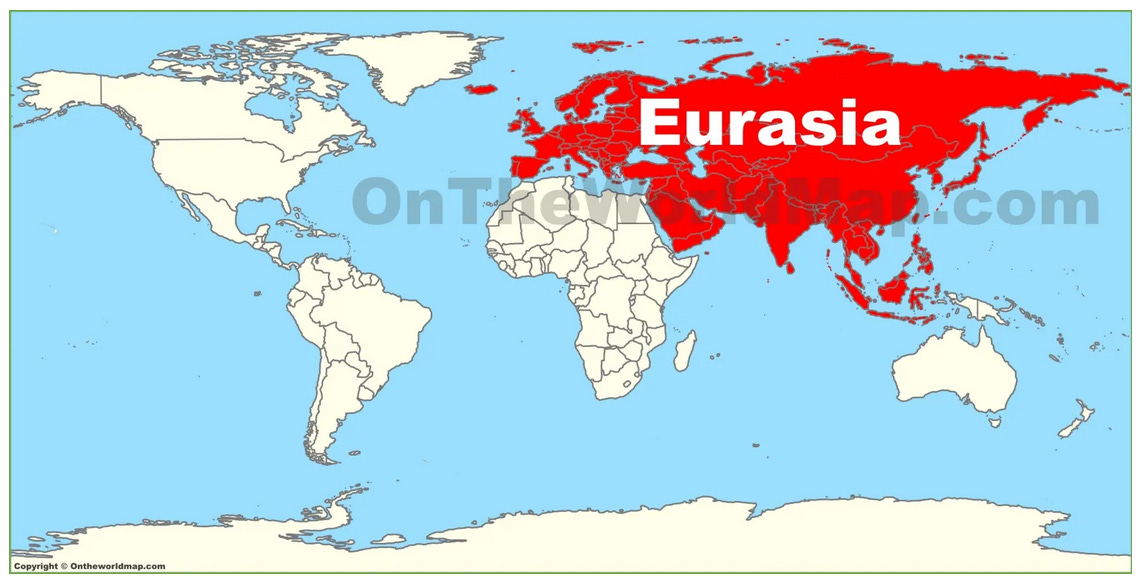
After the fall of the Soviet Union, Dr. Brzezinski asserted the U.S. leadership should concentrate its power to control this landmass:
This huge, oddly shaped Eurasian chess board -- extending from Lisbon to Vladivostok -- provides the setting for “the game.” If the middle space can be drawn increasingly into the expanding orbit of the West (where America preponderates), if the southern region is not subjected to domination by a single player, and if the East is not unified in a manner that prompts the expulsion of America from its offshore bases, America can then be said to prevail.
With the “middle space,” he means Europe, with the “southern region” he refers to the Middle East, and with “East” he refers to China and her neighboring countries, including Russia, as her landmass essentially covers the width of the “chessboard.” These were the developments Dr. Brzezinski noted the U.S. should work against.
But if the middle space rebuffs the West, becomes an assertive single entity, and either gains control over the South or forms an alliance with the major Eastern actor, then America’s primacy in Eurasia shrinks dramatically. The same would be the case if the two major Eastern players were somehow to unite.
Finally, any ejection of America by its Western partners from its perch on the western periphery would automatically spell the end of America’s participation in the game on the Eurasian chessboard, even though that would probably also mean the eventual subordination of the western extremity to a revived player occupying the middle space.
All the actions after the fall of the Soviet Union up until the current war against Iran can be seen as, more or less, calculated actions to establish the U.S. hegemony over Eurasia (and thus the world) following the advice of Dr. Brzezinski. Like explained in the first part of the Grand (Unified) Geopolitical Theory, the EU and especially the war in Ukraine were, most likely, “moves” to establish full control of the Middle (Europe). The main aim, as somewhat covertly recommended by Zbigniew, was to destroy the power of France and Germany to exert their influence over Europe and North Africa. In other words, to “neuter” them through the EU. Considering the speed Europe has sunk itself in the wake of the onset of the Russo-Ukrainian war, we can consider these resounding successes from Washington, until now.
The process the administration of President Trump has put in motion with Iran, which we detail below, goes completely against the advice of Dr. Brzezinski. This is probably because of the hubris that seems to have taken over the Trump administration as well as Israeli, neocon, Zionist, and even Evangelical factions affecting it.
Iran is currently altering the ‘chessboard’ and emerging as something much more than just a “geopolitical pivot,” like she was labeled by Dr. Brzezinski.1 We can expect even more, because Iran still has major firepower in store.
Iran: 26 Days of War and a Still Largely Operational Arsenal
After almost one month of war, Iran’s military arsenal remains largely operational across air, land, and sea domains. This stands in stark contrast with the narrative touted by the White House.
