

Contents:
Round-up of the updated U.S. GDP forecasts with the simplified model.
Forecasts for GDP, including bank lending, indicate a collapse of the U.S. economy commencing shortly, followed by a strong recovery.
We will concentrate on our U.S. economic forecasts in this week’s Weekly Forecasts in two separate reports. In the first, we go through our recent forecasts for the U.S. gross domestic product (GDP) and update the forecasting model with banking lending data on U.S. commercial banks. There are reasonable grounds to assume that lending by banks would add information beneficial to forecasting the path of GDP development. This is simply because most money creation, in any economy, occurs through commercial banks.
And they do. Adding the loans and leases in bank credit series into the forecasting model leads to a notable decline in the mean squared errors of the model. This implies that adding bank lending makes the model more precise and more accurate in explaining the changes in the real GDP. This straightforwardly implies that the forecasts generated by the model would also be more accurate.
The updated forecast keeps on indicating that the U.S. economy would see something of a collapse during the next two quarters. However, it also indicates that a strong recovery would follow, which is of course questionable now.
We also extend the model to take into account the economic shock the Gulf War 2.0 can deliver to the U.S. economy. This Special Issue will be published as soon as the modeling is complete, but no later than next week.
Tuomas
GDP growth forecasts for the U.S.
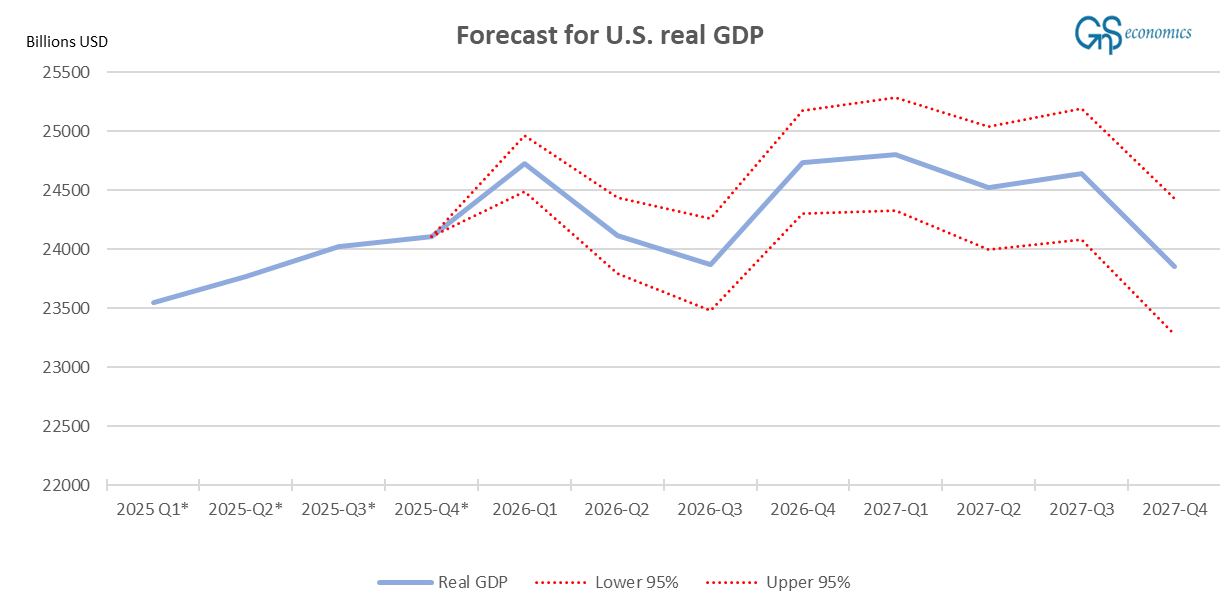
Let’s start by assessing the updated forecasts of our simple model run by Tuomas during the weekend before the previous one. The forecasts indicate that the U.S. economy is expected to enter a slump, followed by a weak recovery, then stagnation, and ultimately another collapse. Figure 1 presents the forecasts.
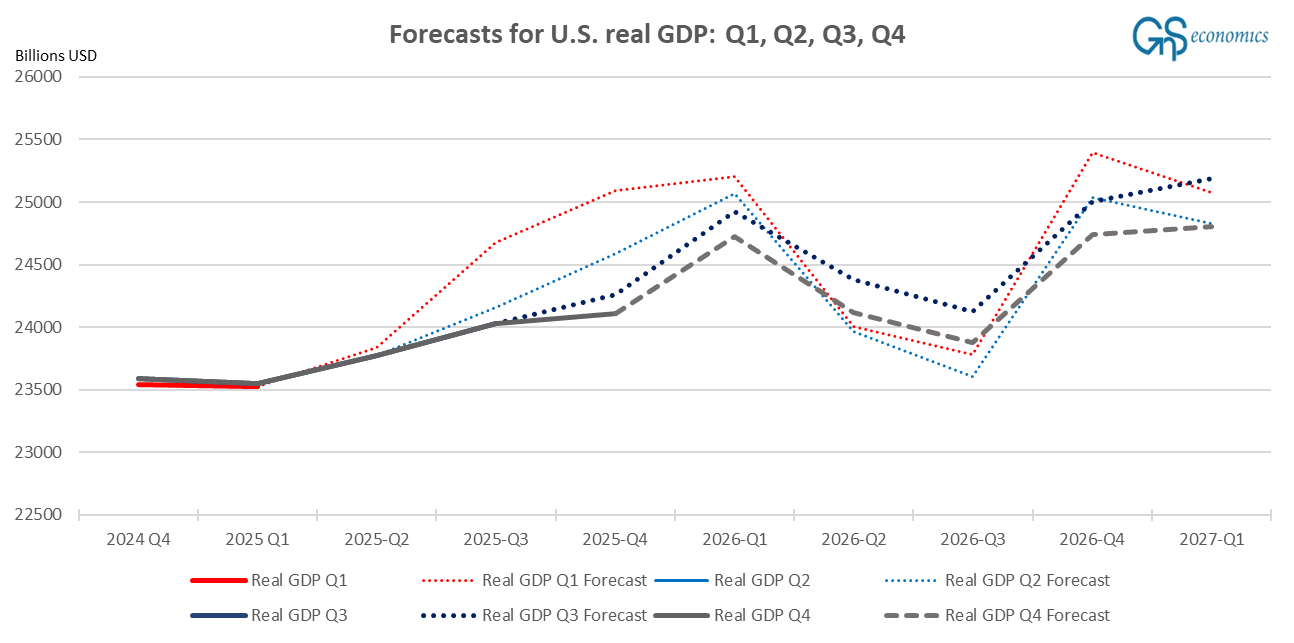
The consistency of the forecasts is what takes our attention and increases our trust in them. Essentially, while the acceleration of the U.S. economy predicted by the forecasting model has diminished notably with data updates, all four forecasts with updated data have continued to indicate that the U.S. economy will experience something of a collapse during Q2 and Q3 this year.
This consistency of predicting “doom and gloom” for the U.S. economy is baffling, in a statistical sense. It is in the nature of statistical forecasts to change, sometimes drastically, with new data. Yet, our model has continued to show the Q2-Q3 collapse, update after update and revision after revision. Figure 3 turns the forecasts into actual (quarter-to-quarter) GDP growth numbers, which continue to be “nonstandardized” implying they are likely to be too large.
