

On March 11, I noted in How will the war end (Ego victor) that:
In other words, I am suspecting that he will switch from “Donald the conqueror” to “Donald the prosperous” in the moment when the first signs of impending economic collapse emerge. I also think that he will walk over Israel, the Deep State, and whoever he wants to sustain his ego as the great economic leader. We’ll probably know before the end of the month whether I was correct.
Last night, we got our first indication of the above when the U.S. and Iran agreed on a ceasefire. But be honest now. Could a U.S. leader really agree to these without an anguishing economic and military defeat?
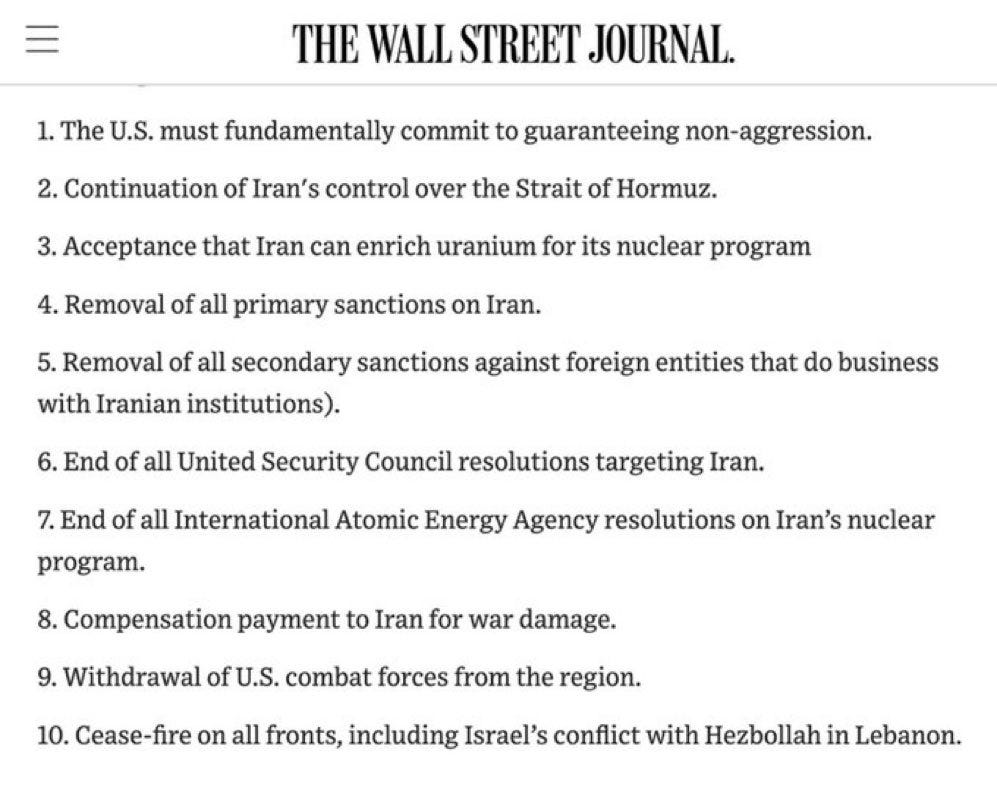
I would say not in a million years.
According to Iranian accounts, China’s role was imperative (and Pakistan’s miniscule) behind the “ceasefire.” If so, such a move would be understandable. Beijing inserts and grows its power quietly, stealthily even, usually through diplomatic channels and economic investments in the region. A catastrophic escalation in the Middle East would have pulled it into the conflict directly, which would have risked it losing the major gains from the conflict thus far. The conflict forced the U.S. to redeploy its THAAD (Terminal High Altitude Area Defense) system from (South) Korea into the Middle East, and the withdrawal of U.S. military forces from the region has started to push China and Taiwan closer together.
I would argue that Beijing wanted to give something to President Trump, who, most likely, desperately tried to get Beijing to pressure Tehran into even a short ceasefire. The ceasefire would give the U.S. military the chance to regain some of its footing and possibly (likely) prepare for a ground invasion. Such an operation is something you simply cannot do if you do not have secure access to the coast (like during D-Day) or to a base with a short land bridge to the country you want to invade (like in every single historical campaign of land invasion).
In my thinking, there are just two ways to end this war, which I described in my game theoretical framework yesterday. While it modeled a nuclear exchange between the two countries, it also applies more broadly to the conflict.
What my model stated was that either Israel capitulates into a major regime change (or utter destruction) or Iran falls. From these, I would say that the former is much more likely than the latter. This is because Iran is 1) a battle-hardened, ancient, and now united society, while 2) Israel is effectively a colony (of whom exactly, we do not know). This comes because modern leadership is vehemently pushing for their Greater Israel plan, acknowledged by many esteemed geopolitical analysts, like one of the most esteemed economists ever, Jeffrey Sachs.
Thus how do we get to this endgame from the current “ceasefire”? Simply through the war continuing after a short pause with a third phase, during which the U.S. makes a desperate land (or oil) grab attempt, which will fail miserably. At the same time, markets crater, and the first signs of an economic collapse appear. At this point, we are likely to face the first real end to the war, which would occur almost immediately after the U.S. withdraws from both the Middle East and Israel. These are extreme options because they would not only end the petrodollar but also diminish Israel’s status as an independent entity (at least in its current form), which is why the war is likely to continue for some time.
However, somewhat counterintuitively, Donald Trump is precisely the right person to do the above, because I think his ego weighs more than the petrodollar, U.S. empire, and Israel combined. I naturally can be mistaken with my assessment, but I think that he may desert everyone to save the U.S. economy. This implies that we have a few weeks of war left.
Whether the war lasts for a few weeks or months from here on, it will continue. Do not trust any ceasefire nonsense. It’s here just to provide a short breather and for markets.
Tuomas
Links updated post-publication on 4/8/2026.
Disclaimer:
The information contained herein is current as of the date of this entry. The information presented here is considered reliable, but its accuracy is not guaranteed. Changes may occur in the circumstances after the date of this entry, and the information contained in this post may not hold true in the future.
No information contained in this entry should be construed as investment advice nor advice on the safety of banks. Neither GnS Economics nor Tuomas Malinen can be held responsible for errors or omissions in the data presented. Readers should always consult their own personal financial or investment advisor before making any investment decision or decision on banks they hold their money in. Readers using this post do so solely at their own risk.
Readers must assess the risks and legal, tax, business, financial, or other consequences of their actions. GnS Economics and Tuomas Malinen cannot be held i) responsible for any decision taken, act, or omission or ii) liable for damages caused by such measures.
The views of Tuomas are his own. They may or may not be endorsed and supported by the partners and staff of GnS Economics.